A mansion that rewards looking
The Council, the narrative adventure by Big Bad Wolf released in 2018, begins in 1793. Louis de Richet arrives on Lord Mortimer’s island looking for his missing mother. Between conversations, the walls offer another kind of encounter: familiar paintings, displaced from the churches, houses and civic institutions for which they were made.
Some can be inspected and commented on; some become clues. They also change the atmosphere before anyone speaks. A room full of suspended bodies, threatening gestures and broken authority makes a different promise from a room full of landscapes. That is our reading of the setting, not a claim that every painting conceals a puzzle.
This route follows seven works associated with the game. Five were matched directly to gameplay images; Rubens’s The Fall of Phaeton and Rembrandt’s The Night Watch are identified in the community’s annotated gallery catalogue. We checked the real objects against institutional records. There are no puzzle solutions or story revelations here. The reproductions show the artworks, not game screenshots.
Rubens: a chariot beyond control
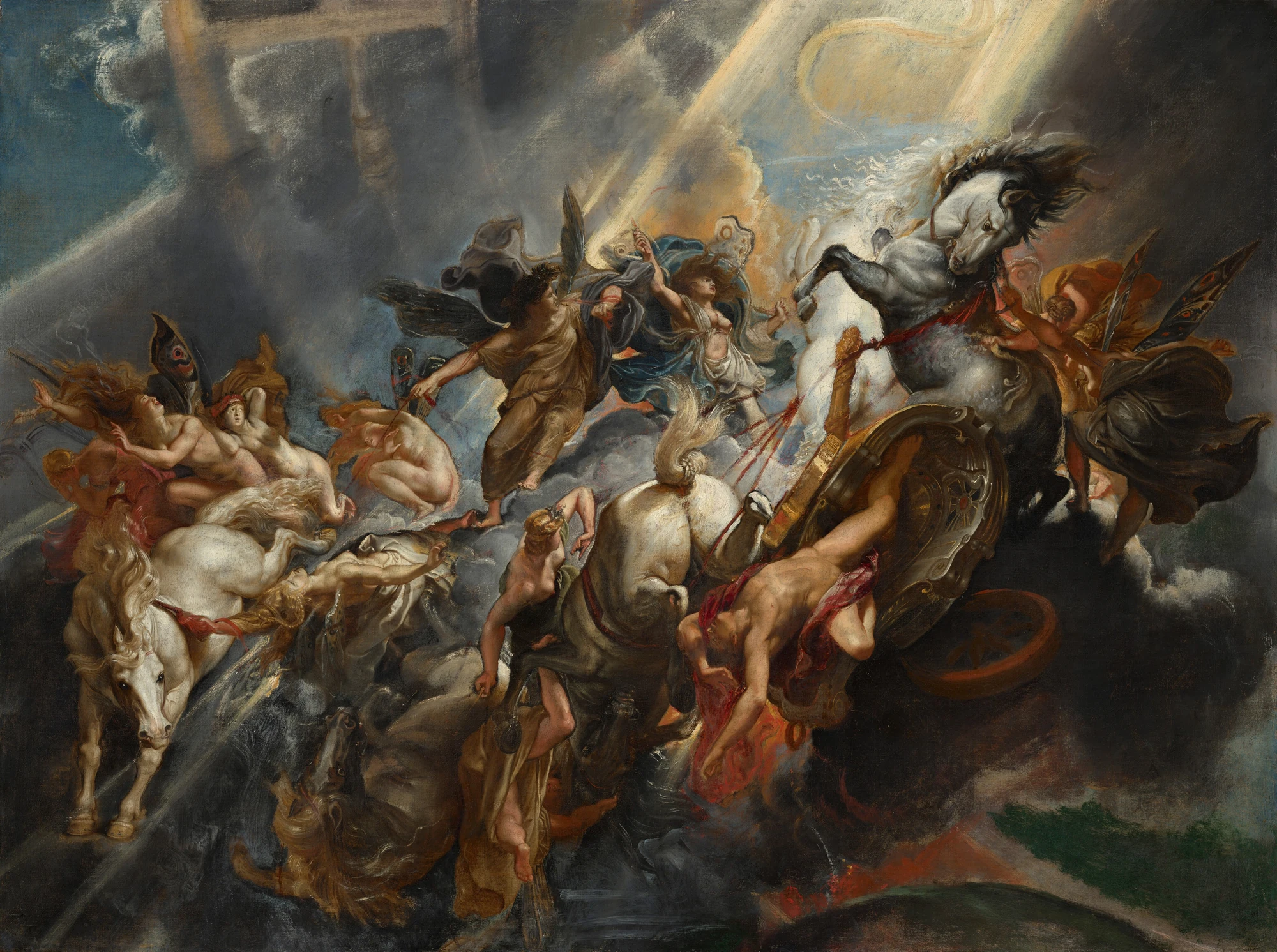
Peter Paul Rubens, The Fall of Phaeton, c. 1604/1605, probably reworked c. 1606/1608. Oil on canvas. National Gallery of Art, Washington.
The community’s annotated gallery catalogue identifies this work in the game. In the ancient myth, Phaeton takes the sun’s chariot and cannot control it; Jupiter intervenes with a thunderbolt. Rubens makes the disaster almost impossible to untangle. Look at the horses first. Their bodies pull away from one another, while the falling figures interrupt any clear boundary between sky, cloud and flesh.
The composition is busy, but the eye has a route: follow the bright diagonal from the upper right into the cluster of bodies, then let the darker clouds return you to the light. Paint becomes a way to organize collapse. In the mansion’s gallery, this is an apt image to encounter among powerful people: the ability to seize the reins and the ability to govern are different things. That association is an interpretation, not a solution to the plot.
Goya: a painting from the wrong century
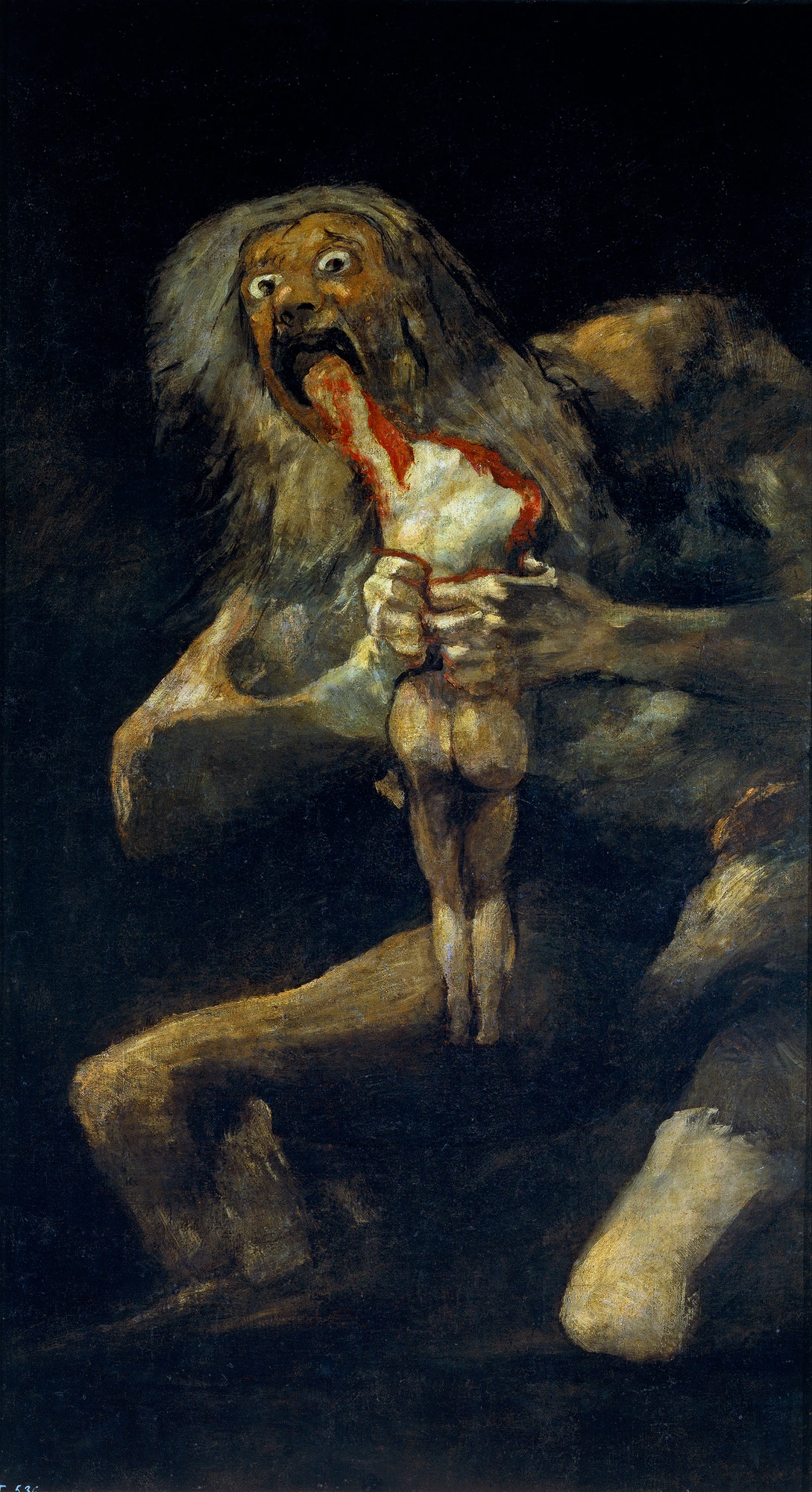
Francisco de Goya, Saturn, c. 1820–1823. Wall painting incorporating oil, later transferred to canvas. Museo Nacional del Prado, Madrid.
This is the most immediate rupture in the collection’s chronology. The game begins in 1793; Goya’s painting belongs roughly three decades later. The mismatch is worth noticing without trying to explain it through the story. It also makes this fictional house an unreliable place to learn a timeline of art.
Saturn was one of the Black Paintings on the walls of Goya’s Quinta del Sordo. A museum reproduction can make it seem like an ordinary easel painting; its original support was part of a house. The transfer to canvas changed the kind of object it was. The work’s present museum setting and the game’s ornate frame are two very different contexts for the same image.
Look at the hands and eyes before the surrounding darkness. The hands close tightly around the body, while the wide eyes seem unable to settle. Much of the figure emerges without a fully described setting. The effect depends on what Goya leaves indistinct as much as on what he illuminates. In The Council, its presence unsettles a room even before the player knows what to make of it.
 View
Saturn, c. 1820–1823Museo Nacional del Prado, Madrid
Wall painting incorporating oil, later transferred to canvas · 143.5 × 81.5 cm
Museo Nacional del Prado, Madrid, P000763. Reproduction via Wikimedia Commons.
Public Domain Mark 1.0 · Museum record · Terms of use
Fuseli: which Nightmare?
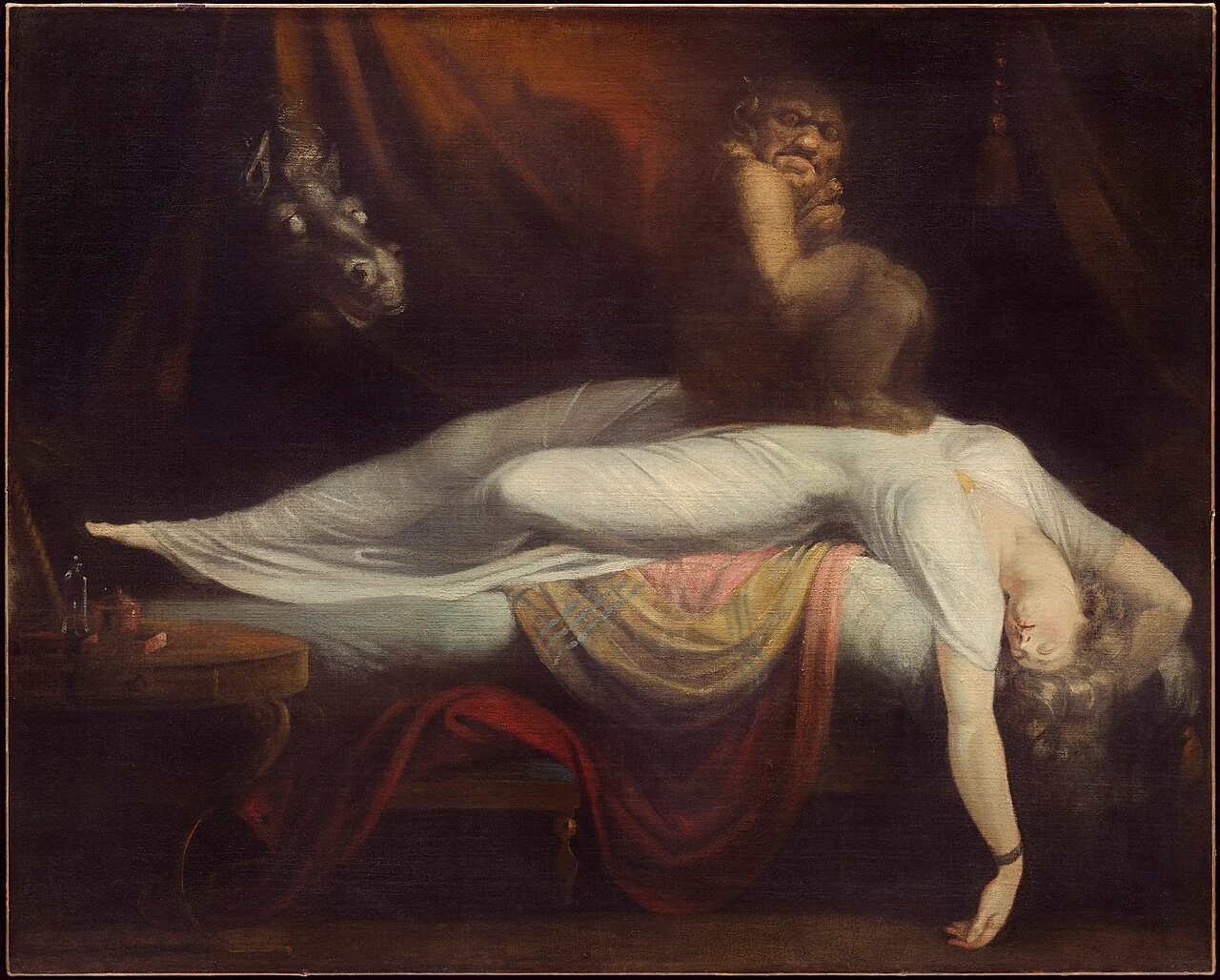
Henry Fuseli, The Nightmare, 1781. Oil on canvas. Detroit Institute of Arts, Detroit.
The version visible in Mortimer’s study has the sleeper’s head hanging to the right, a crouching creature over her torso and a horse emerging at the upper left. Those details matter: the Swiss-born Fuseli painted another version, now in Frankfurt, with a different orientation and format. A shared title does not identify a particular object.
The Detroit composition gives the sleeping figure a long, almost continuous pale outline. The creature interrupts that line with its compact weight. The horse’s head arrives from a space that the curtains ought to conceal. Look from the three faces to the edges of the bed: the room feels shallow, but its darkness seems to continue beyond it.
The painting serves as a clue in the game. We can leave its use there and still see why it belongs in this house: something private and apparently passive, a sleeper alone, becomes a scene of scrutiny and pressure.
 + View
The Nightmare, 1781Detroit Institute of Arts, Detroit
Oil on canvas
Image · Public domain
Caravaggio: the first Conversion of Saul
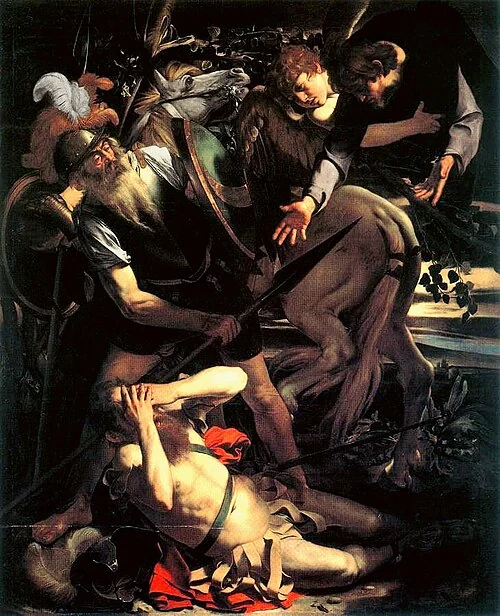
Caravaggio, Conversion of Saul, first version, commissioned in 1600. Oil on cypress panel. Private collection of Nicoletta Odescalchi, Rome.
Here the game offers a particularly easy trap for an image search. Its composition shows Saul shielding his face with bent arms amid several figures. This is the Odescalchi painting, not the better-known canvas in the Cerasi Chapel of Santa Maria del Popolo, where a great horse stands above the fallen man’s open arms.
The support is unusually specific: seven horizontal cypress boards. The first painting was not installed in the chapel; the reason remains under study. The existence of a later version does not justify repeating the familiar story that the commissioner simply rejected it.
Compare how the two pictures direct attention. The earlier scene asks the eye to move among several bodies and gestures; the later one concentrates the encounter within a much quieter arrangement. In a game that asks you to identify what you are looking at, that distinction becomes practical. And “where is it now?” needs a precise answer: this is a private collection, not a promise of permanent public access. Its Palazzo Barberini display in 2025 was a temporary exhibition.
 + View
The Conversion of Saul: the First Version, c. 1600–1601Odescalchi collection, Rome
Oil on cypress panels
Rembrandt: a public company in a private house
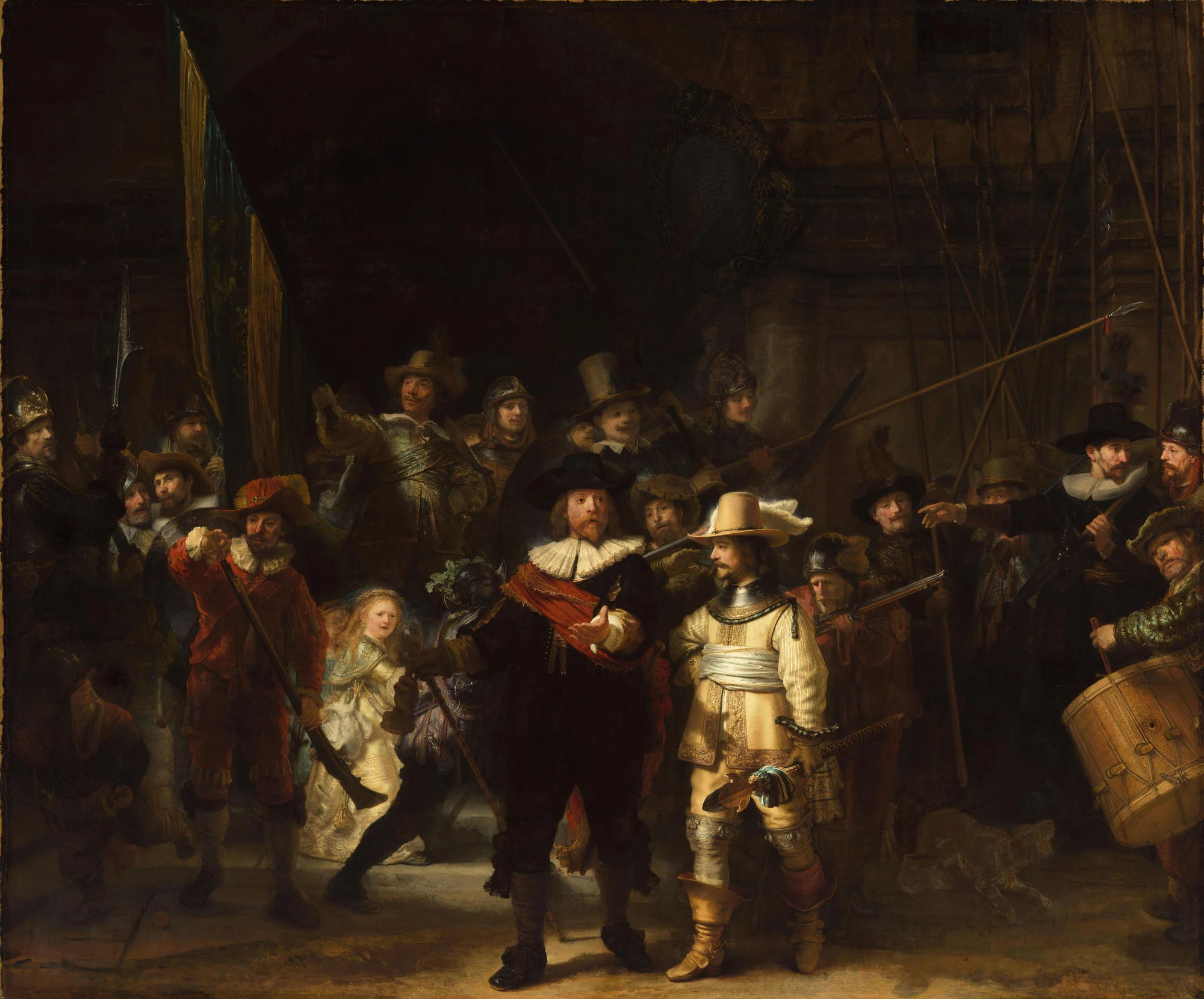
Rembrandt van Rijn, The Night Watch, 1642. Oil on canvas. Rijksmuseum, Amsterdam; on loan from the City of Amsterdam.
The same community catalogue identifies The Night Watch among the gallery paintings. It is a group portrait of an Amsterdam civic guard company. Moving that image into Mortimer’s house removes it from its public, collective purpose and turns it into part of a private host’s display. That change of setting is worth considering even when a picture is not functioning as a clue.
Rembrandt refuses to give every face equal light or every body an unobstructed place. Hands, weapons and sleeves compete; the two foreground officers give the crowd a direction. Try following the captain’s outstretched hand, then the pale figure behind him. The light edits the group into a sequence of encounters.
This offers a useful comparison with the game itself. A room can contain many people while directing our attention toward just two or three. Selection creates a story; the rest of the room remains available to a second look.
 View
The Night Watch, 1642Rijksmuseum, Amsterdam
Oil on canvas · 379.5 × 453.5 cm
Rijksmuseum, Amsterdam. On loan from the City of Amsterdam, SK-C-5.
Public Domain Mark 1.0 · Museum record · Terms of use
Leonardo: the frame conceals a wall
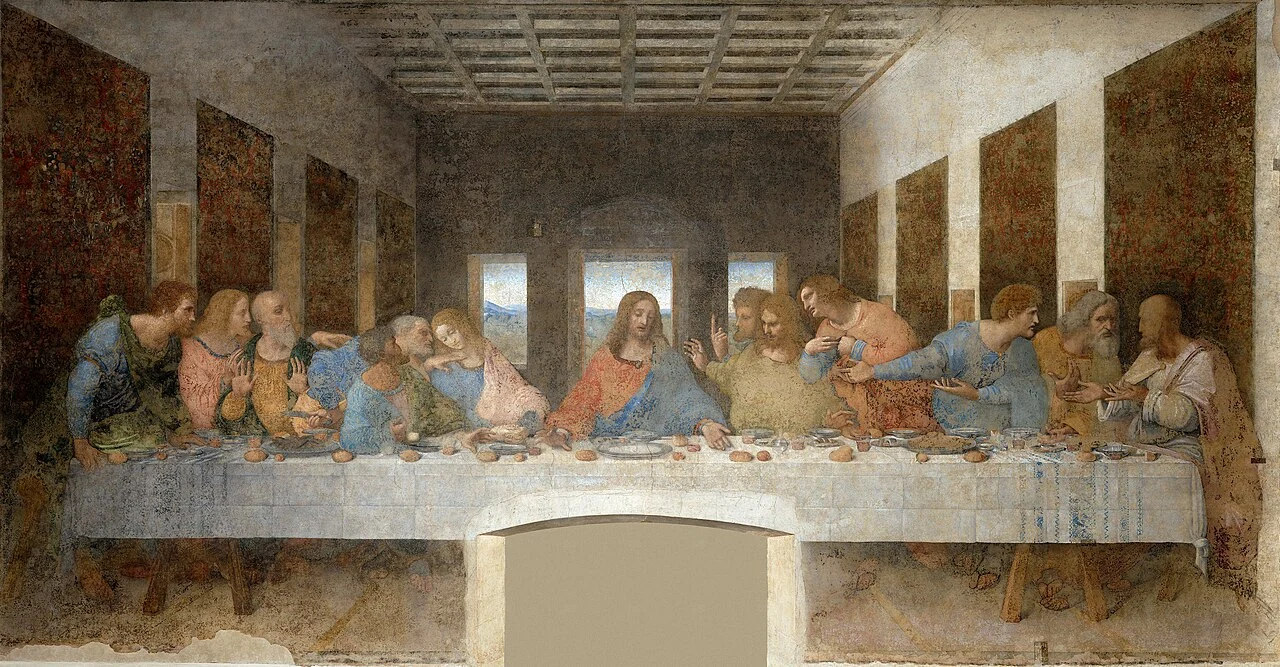
Leonardo da Vinci, The Last Supper, 1495–1498. Painting on dry plaster. Refectory of Santa Maria delle Grazie, Milan, cared for by the Museo del Cenacolo Vinciano.
The gallery in The Council contains a framed adaptation of this composition. The real work is a wall painting still in its architectural setting. It is also not a conventional fresco: Leonardo worked on dry plaster, a choice that allowed a different working rhythm from painting into wet plaster.
The game image retains a continuous lower part, unlike the present wall in Milan with its later doorway. That alone warns against treating a game texture as a photograph of the surviving original. We can identify the composition without claiming to know which intermediate copy or reconstruction the developers used.
Follow the ceiling lines toward Christ, then look sideways along the table. The architecture gathers attention at the center; the apostles’ hands and bodies send it outward again. Even inside a smaller fictional frame, that tension survives. The screen carries a composition across places and formats while concealing much of the object’s material history.
 + View
The Last Supper, 1495–1498Museo del Cenacolo Vinciano, Milan
Experimental painting on dry plaster
Image · Public domain
Regnault: politics becomes an image
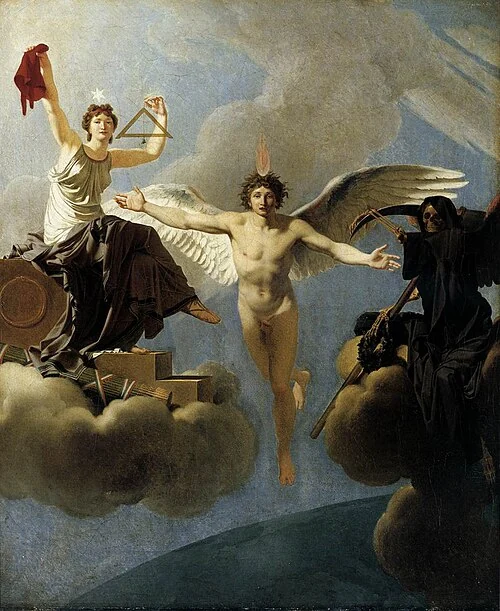
Jean-Baptiste Regnault, Liberty or Death, c. 1794. Oil on canvas. Hamburger Kunsthalle, Hamburg.
The game shows Regnault’s composition. The smaller version survives in Hamburg; the frame alone does not establish which version supplied the game image.
A winged figure holds out both arms between a personification of the Republic and Death. Regnault gives an abstract political choice a body and a pose: the alternatives occupy either side of the canvas, with the central figure facing us. The painting was shown at the Paris Salon in 1795. The museum’s recent catalogue dates it around 1794; an older museum essay gives 1794/95. Either places it after the game’s opening date.
Beside the religious and mythological scenes, this work introduces a different kind of authority: the revolutionary demand to choose. It is a useful reminder that classical-looking bodies do not necessarily belong to the ancient world. In late eighteenth-century painting, they could carry urgent contemporary arguments.
 + View
Liberty or Death (The Genius of France between Freedom and Death), c. 1794–1795Hamburger Kunsthalle, Hamburg
Oil on canvas
Image · Public domain
A way to look beyond the game
The mansion puts radically different objects on apparently equal terms: an Amsterdam group portrait, a Roman altarpiece, a Milanese wall painting, an image once painted inside Goya’s home. Its collection is compelling partly because those original distances and functions have collapsed.
On a second look, ask three questions. What is the subject? How does light or gesture guide the eye? What was the original object made for, and where does it belong? A museum record answers the last question more reliably than a fictional wall label. The pleasure is in moving between them: recognizing an image in the game, then discovering that its real history is stranger or more particular than the familiar title suggests.
Five identifications in this selection were checked against gameplay footage or still images. The Rubens and Rembrandt entries rely on the community’s annotated gallery catalogue; we have not independently matched them to a gameplay frame. Facts about the real works were checked against institutional records. Collection locations are not guarantees of current display. The gameplay references below may contain spoilers beyond the frames used for identification.
Sources
- The Council · Official game description and 1793 setting
- Focus Entertainment · Developer diary, Rethinking Narrative Adventure
- Gameplay reference · The Nightmare at 33:57 (video may contain spoilers)
- Gameplay reference · Conversion of Saul at 20:51 (video may contain spoilers)
- Game still · A framed Last Supper composition
- Game still · Liberty or Death in the gallery
Courtesy National Gallery of Art, Washington. Patrons’ Permanent Fund, 1990.1.1.
CC0 1.0 · Museum record · Terms of use