Start with the distances
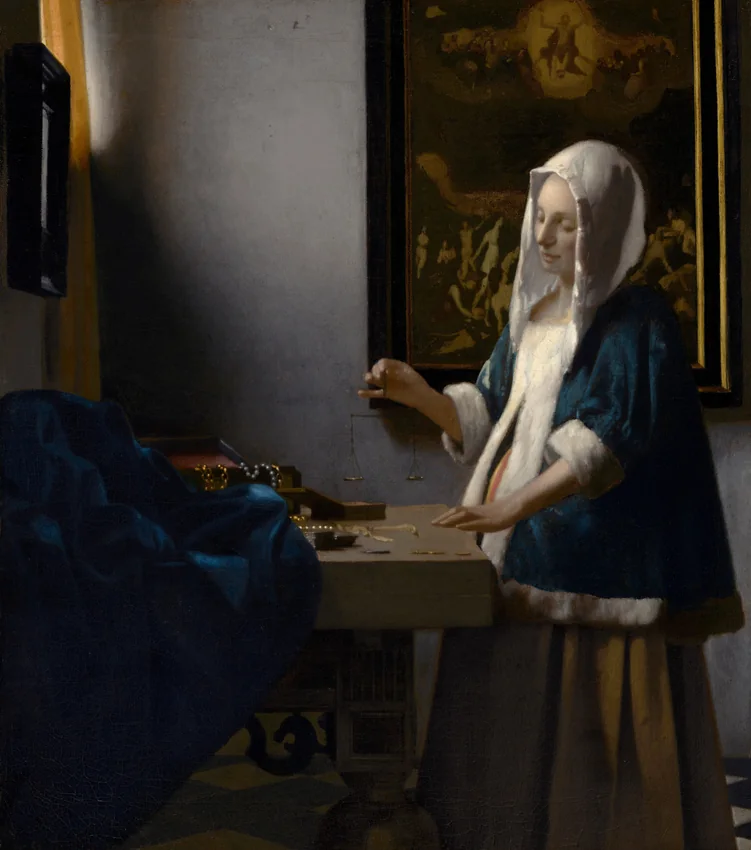
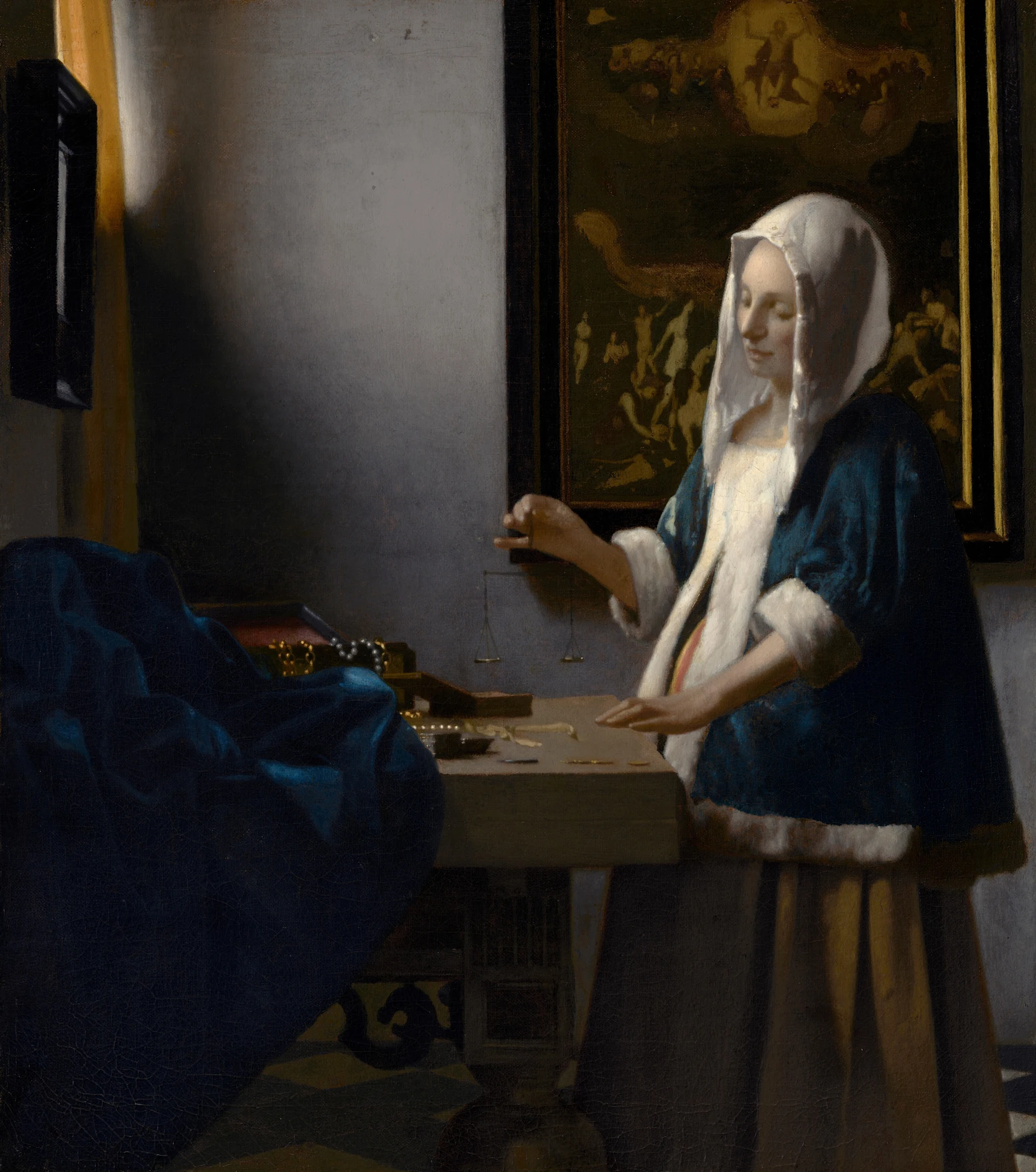
Composition is the placement of figures, objects, and open areas within a painting and the relationships among them. To get a sense of these relationships, shrink the reproduction. The details fall away, leaving a few broad areas: a light wall, a dark frame, a figure, a table. Where did your eye pause first? Which area did it barely register? Now open the image at a larger size. Sometimes the most important gesture is in a part of the painting that looked empty at first.
A balance and the space around it
In Vermeer’s Woman Holding a Balance, the pans and their threads hang in front of a bare patch of wall. Technical examination shows that the artist enlarged and lowered the balance as he worked. Extend a horizontal line in your mind along the lower edge of the frame. Without the break, the finer parts of the balance would cross that heavy boundary. The strip of bare wall gives the pans room to be seen. Below it, another gap separates them from the objects on the table. Compare the two intervals. One gives the balance a background, and the other leaves space for an imagined movement.
When the object is a cathedral
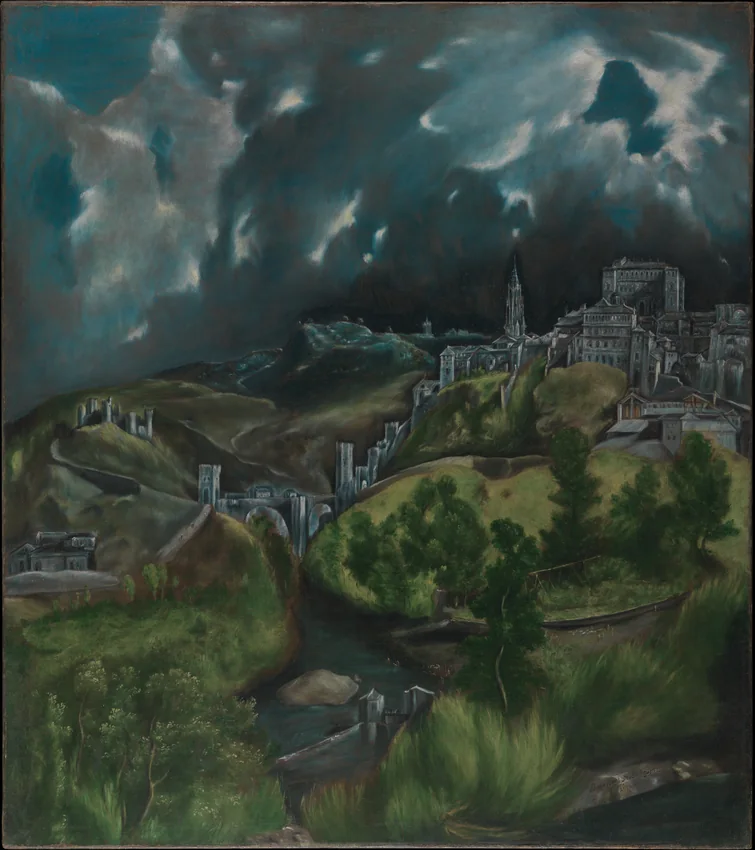
In View of Toledo, El Greco moves the cathedral from its location in the real city. Gauge the height of the spire, then the width of the space that separates it from the bulk of the building nearby. That interval is particularly clear in a small reproduction. The city reads as a series of rises and falls that includes the sky between the roofs. Compare it with the gap around the balance. One painter works with inches inside a room; the other with the layout of a city. In both cases, open space is an active part of the painting. See what its neighbor would lose if that interval narrowed.
Sources
- National Gallery of Art, Washington · Woman Holding a Balance
- National Gallery of Art, Washington · Scholarly entry on Woman Holding a Balance
- The Metropolitan Museum of Art · View of Toledo
- Metropolitan Museum Journal · Three Paintings by El Greco
Courtesy National Gallery of Art, Washington. Widener Collection
CC0 1.0 · Museum record · Terms of use