Between window and table
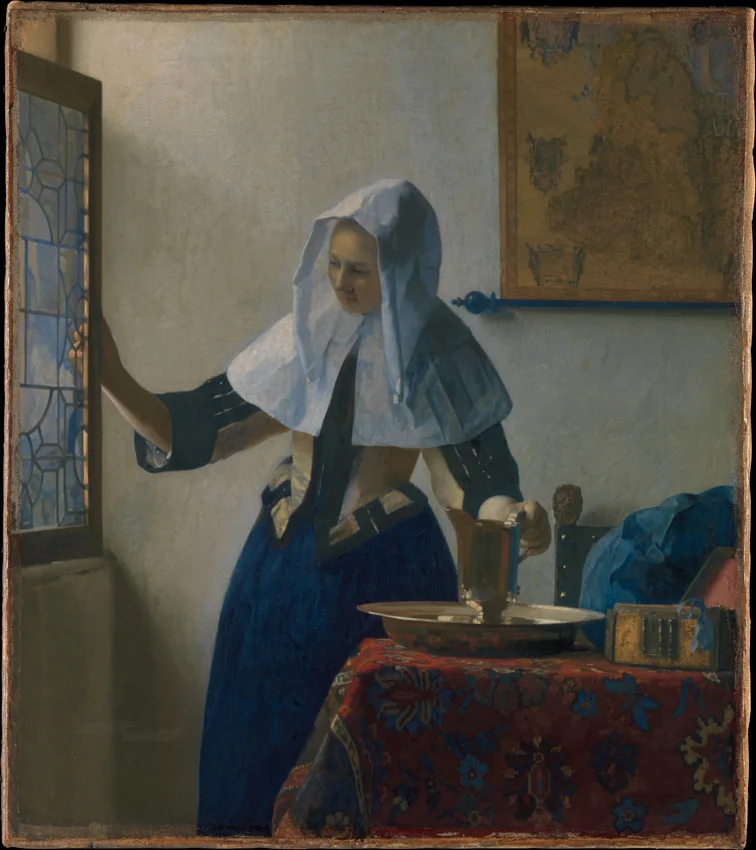
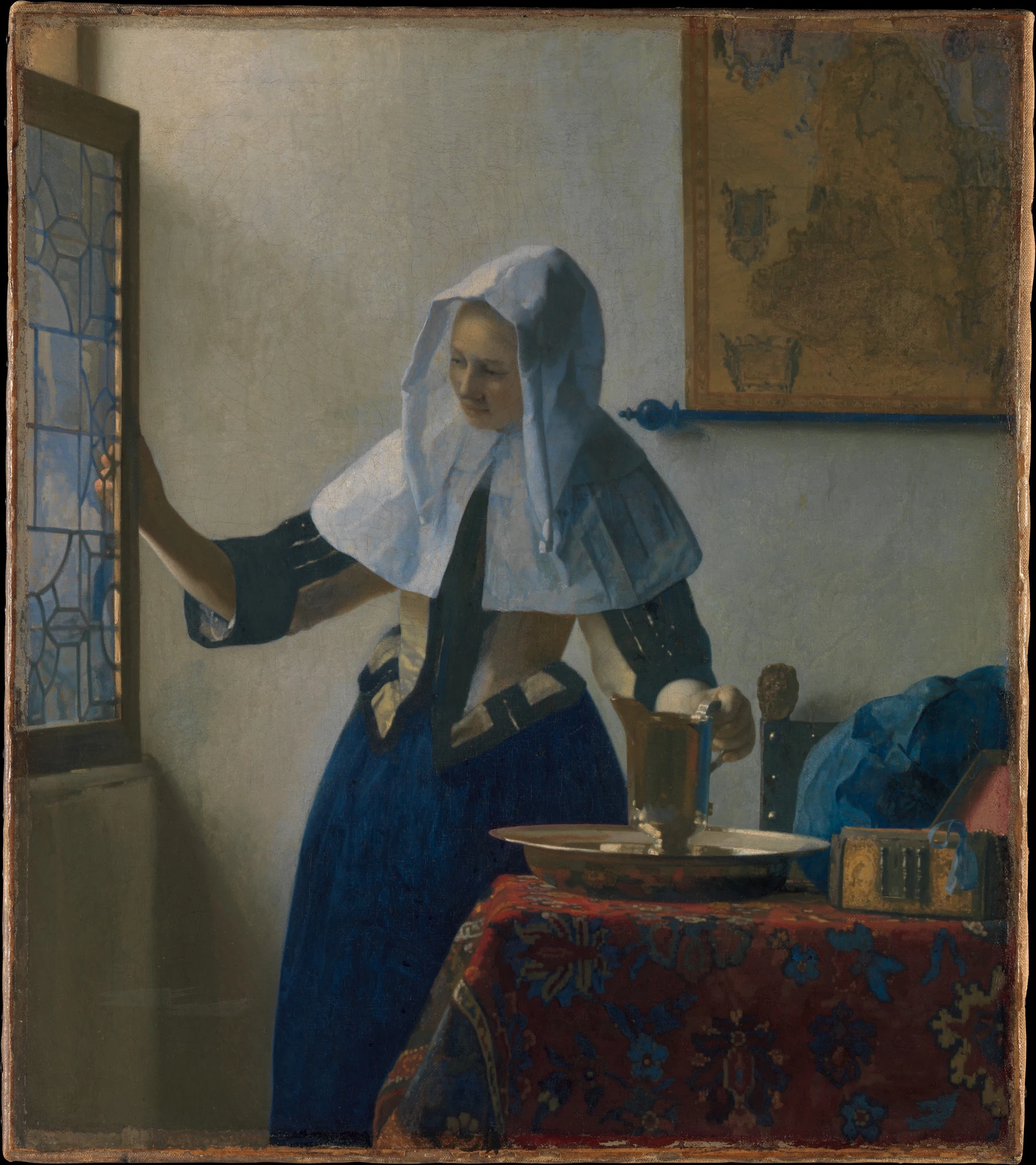
In Young Woman with a Water Pitcher (ca. 1662), the woman holds the window frame with one hand and takes the pitcher by its handle with the other. The Metropolitan Museum of Art identifies the scene as part of her morning toilette. Set that explanation aside for a moment and look at the hands alone. They connect the window on the left to the table on the right, with her pale head covering in between. Cover the bottom of the image and one of the gesture’s anchors disappears. The tilt of the head immediately feels different.
Where white ends
The linen looks white, though much of it is blue and gray. The tones are cooler beside the window, with lighter patches on the raised folds. Move from the fabric to the pitcher and basin. Instead of broad, soft transitions, there are short flashes of light that break off almost at once. A few marks on the rounded surface are enough to suggest the curve of the vessel. Even at a small scale, the way the light breaks across them is enough to tell the two materials apart.
A room made of straight lines
Step back from the screen. The rectangles of the window and map, the edge of the table, and the back of the chair come into focus. The line from the woman’s head to the pitcher cuts across them diagonally, but the movement soon stops. Her hand has reached the handle, and the window is already ajar. Vermeer holds the gesture at a point where either motion could still continue. Look for a tiny detail that changes your sense of the room. The bright rim of the pitcher sends the eye back to the wall, where it registers the depth between the objects on the table and the map.