Finding the balance
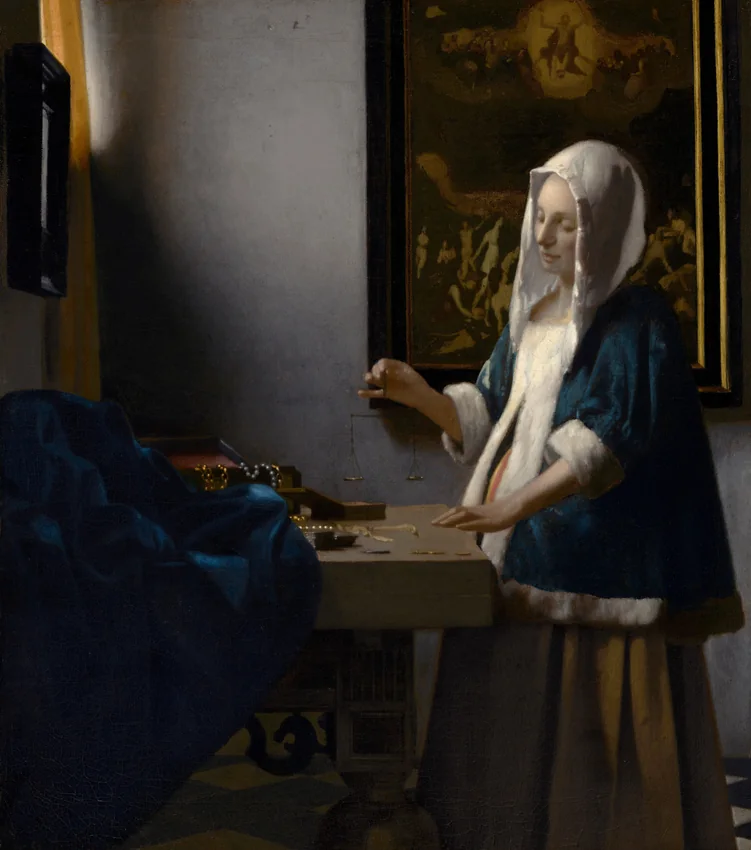
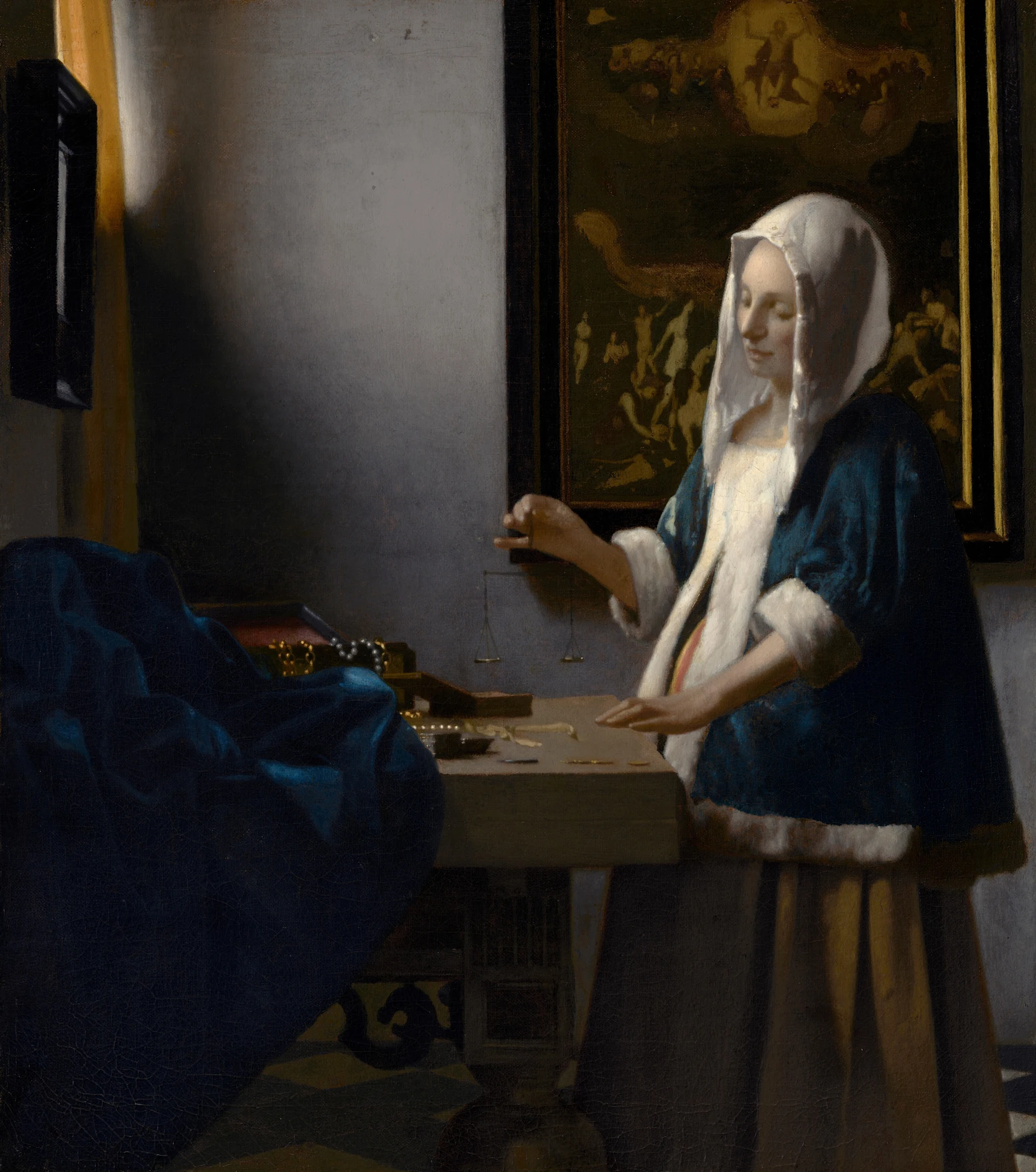
In the small painting Woman Holding a Balance (ca. 1664), the face, the light trim of the jacket, and the dark rectangle of the frame register first. The balance takes longer to find. Start at the raised hand and follow the thin lines down to the pans. There is almost nothing else on this patch of wall. Shrink the image and the pans disappear before the fingers, but the broad space around the hand remains. Return to full size and notice where your eye stays longest: on the pans or on the fingers holding them in position.
Beneath the paint
Researchers at the National Gallery of Art in Washington used infrared reflectography to establish that Vermeer enlarged and lowered the balance as he worked. In the finished painting, the bottom edge of the frame sits higher to the woman’s left than it does behind her. This small adjustment gives the hanging lines a quiet background. Imagine a straight line running along the bottom edge of the frame. Lower the left side to the level of the right, and the fine lines of the balance would have to compete with the border between frame and wall.
What gives empty space weight
Open boxes and jewelry sit on the table, and the picture behind the woman depicts the Last Judgment. One interpretation offered by the gallery connects the act of weighing with the act of judging. Even without that reading, you can see what their proximity does. The table and frame occupy large areas of the canvas. The hand and balance are tiny between them, yet they hold the center of the picture. Consider the distance from the fingers to the pans. Vermeer makes that interval worth looking at alongside the woman’s face and the objects on the table.
Sources
- National Gallery of Art, Washington · Woman Holding a Balance
- National Gallery of Art, Washington · Scholarly entry on Woman Holding a Balance
- National Gallery of Art, Washington · Reconsidering Vermeer’s Perfectionism
Courtesy National Gallery of Art, Washington. Widener Collection
CC0 1.0 · Museum record · Terms of use