A face emerging from shadow
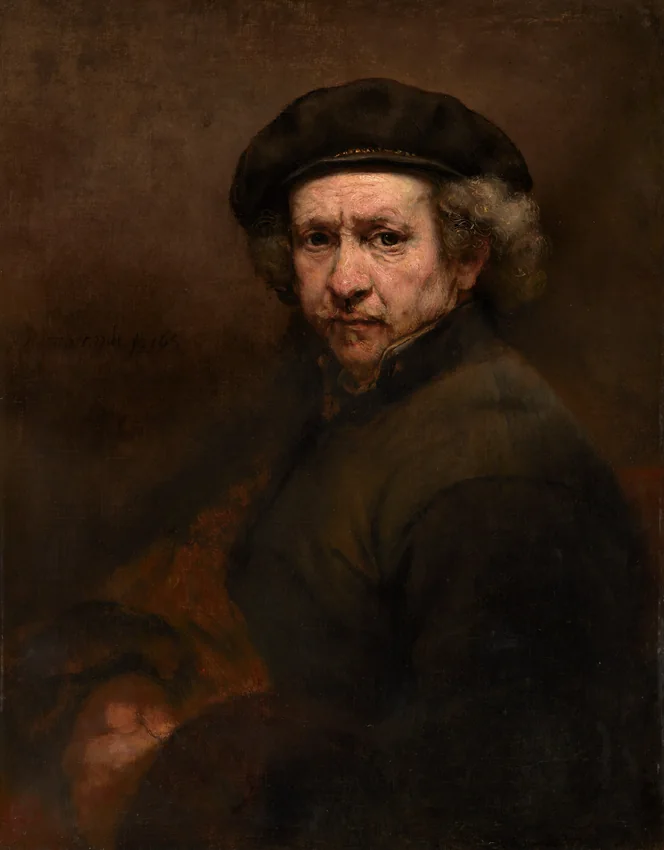
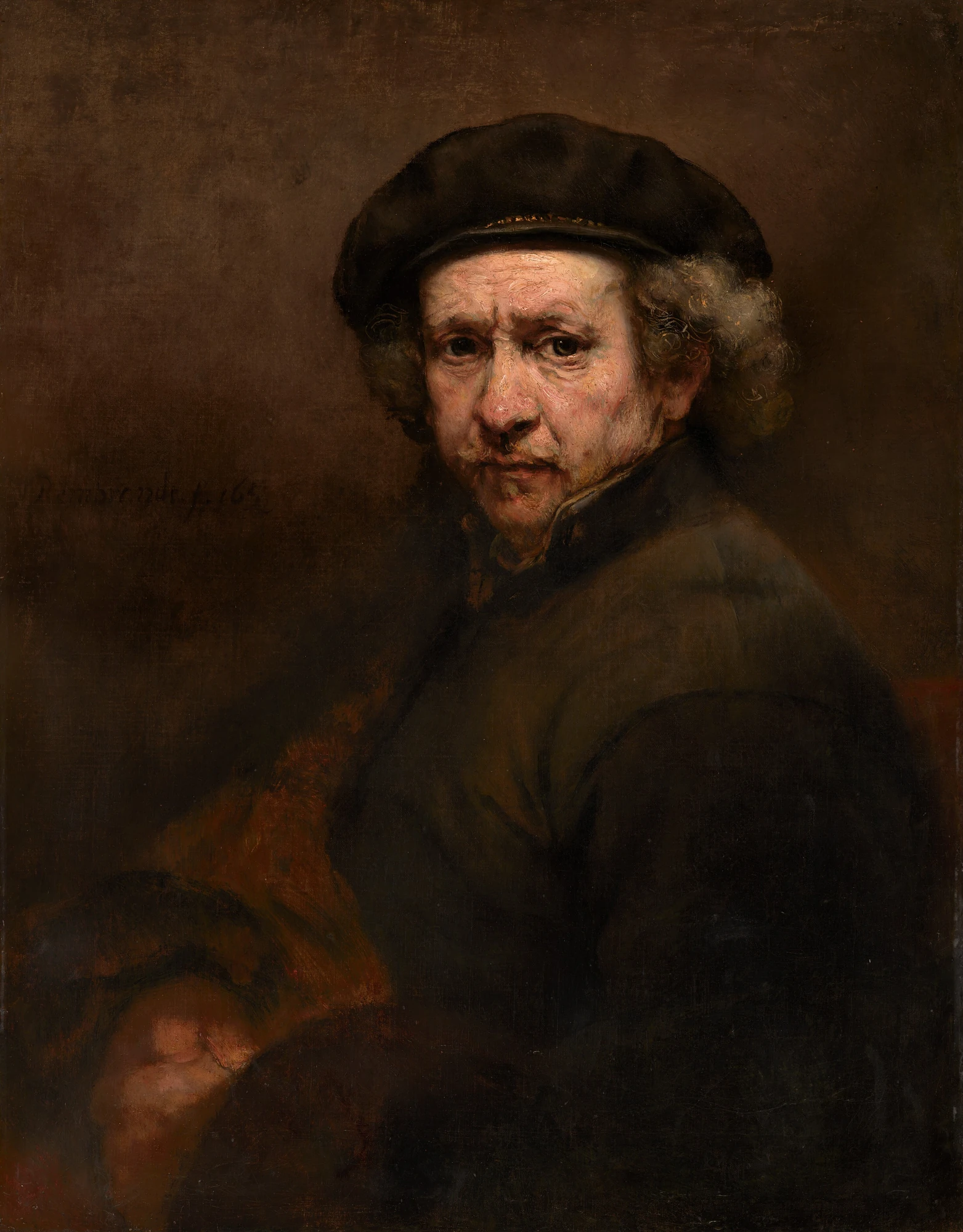
In the Self-Portrait of 1659, the shoulders turn to the left while the face addresses the viewer. The dark collar closes beneath the chin, and the hands all but disappear into shadow. Where the light falls, the forehead and cheek take up relatively little of the canvas. View the painting from farther away. The small folds in the clothing drop out, but you can still read the turn of the head. The edges of the coat dissolve into the background in places. On the forehead and cheek, tones change rapidly as the form turns.
Both ends of the brush
The National Gallery of Art’s technical account describes two distinct operations. For the light areas of the face, Rembrandt applied thick paint in short strokes and worked them into the still-wet layer. He later added darker strokes in places after the paint had dried. Some of the curls beneath the beret were scored into wet paint with the handle of the brush. At close range, those lines look different from the bristle marks on the cheek. One action deposits paint on the canvas. The other cuts a groove in what is already there.
Where the painter stops
Compare the forehead and the hands. On the forehead, individual touches of the brush remain visible. The clasped hands are legible chiefly by their outline. Stare at them long enough and you may find yourself supplying details that Rembrandt gives you very little help to see. Return to the face and the brushwork is suddenly out in the open. The portrait was painted shortly after the sale of the artist’s possessions, but his expression alone gives little access to his thoughts. The tension is easier to locate in things we can see: the direct gaze, the creases above the eyes, and the hands almost lost in shadow.
Sources
- National Gallery of Art, Washington · Self-Portrait
- National Gallery of Art, Washington · Scholarly entry on Rembrandt’s Self-Portrait
- The National Gallery, London · Impasto
Courtesy National Gallery of Art, Washington. Andrew W. Mellon Collection
CC0 1.0 · Museum record · Terms of use