A gesture in place of action
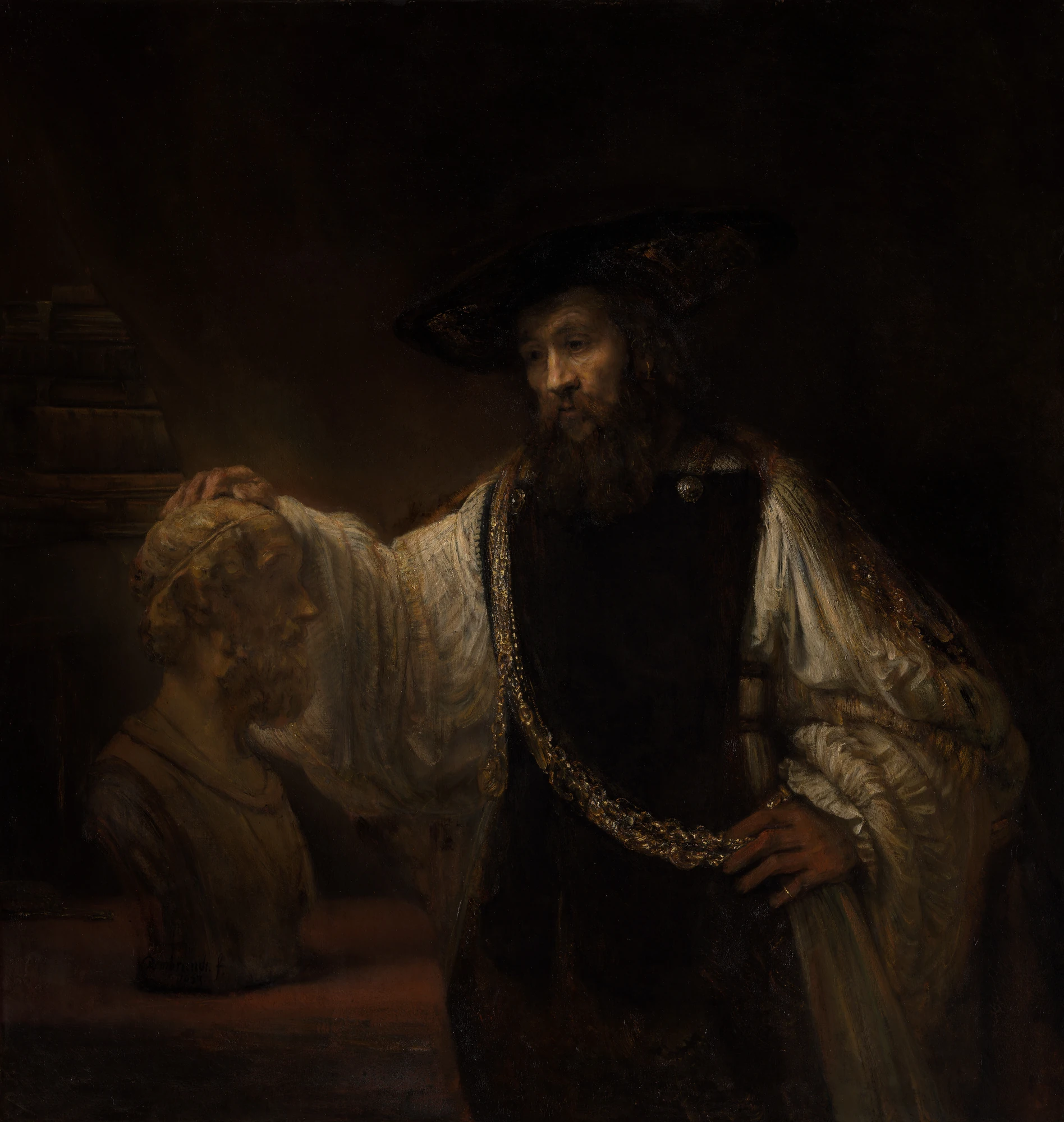
In the painting of 1653, Aristotle lays a hand on the marble head of Homer. His palm rests on the bust, his fingers hang over its edge, and his gaze passes beyond the stone face. The bust is high enough for him to reach without leaning. Imagine it a little lower and the gesture starts to look like an effort. Here, the hand seems to be at rest. The moment can stretch out because there is plenty to look at and almost nothing for the figures to do.
From marble to gold
Follow the line from the fingers up the bright sleeve, then down the gold chain. The medallion shows Alexander the Great, Aristotle’s pupil. A single movement of the eye links three people, only one of whom has a living body. Homer appears as a stone bust, Alexander as a tiny image, and the philosopher as a figure filling most of the canvas. The chain catches the light in small, frequent flashes, while the light falls on the bust in broader areas. Look closely at the surfaces. The gleam of metal and the dull finish of the stone register well before the likeness on the medallion.
Whom did the patron recognize?
Rembrandt painted the work in Amsterdam for the Sicilian collector Antonio Ruffo. An early inventory hesitated between Aristotle and Albertus Magnus, so the current title was hardly a foregone conclusion. The Metropolitan Museum of Art reads the chain and bust as an invitation to weigh worldly fame against the lasting reach of poetry. Try testing that reading against the composition by covering each object in turn. Take away the chain and a pensive man remains beside a sculpture. Take away the bust and the outstretched hand loses its reason for being there. Together, the objects make the portrait a question.
Sources
- The Metropolitan Museum of Art · Aristotle with a Bust of Homer
- The Metropolitan Museum of Art · Rembrandt and the Ancients
- The Metropolitan Museum of Art · Greek Art from Prehistoric to Classical
Purchase, special contributions and funds given or bequeathed by friends of the Museum, 1961
CC0 1.0 · Museum record · Terms of use