Start by looking straight on
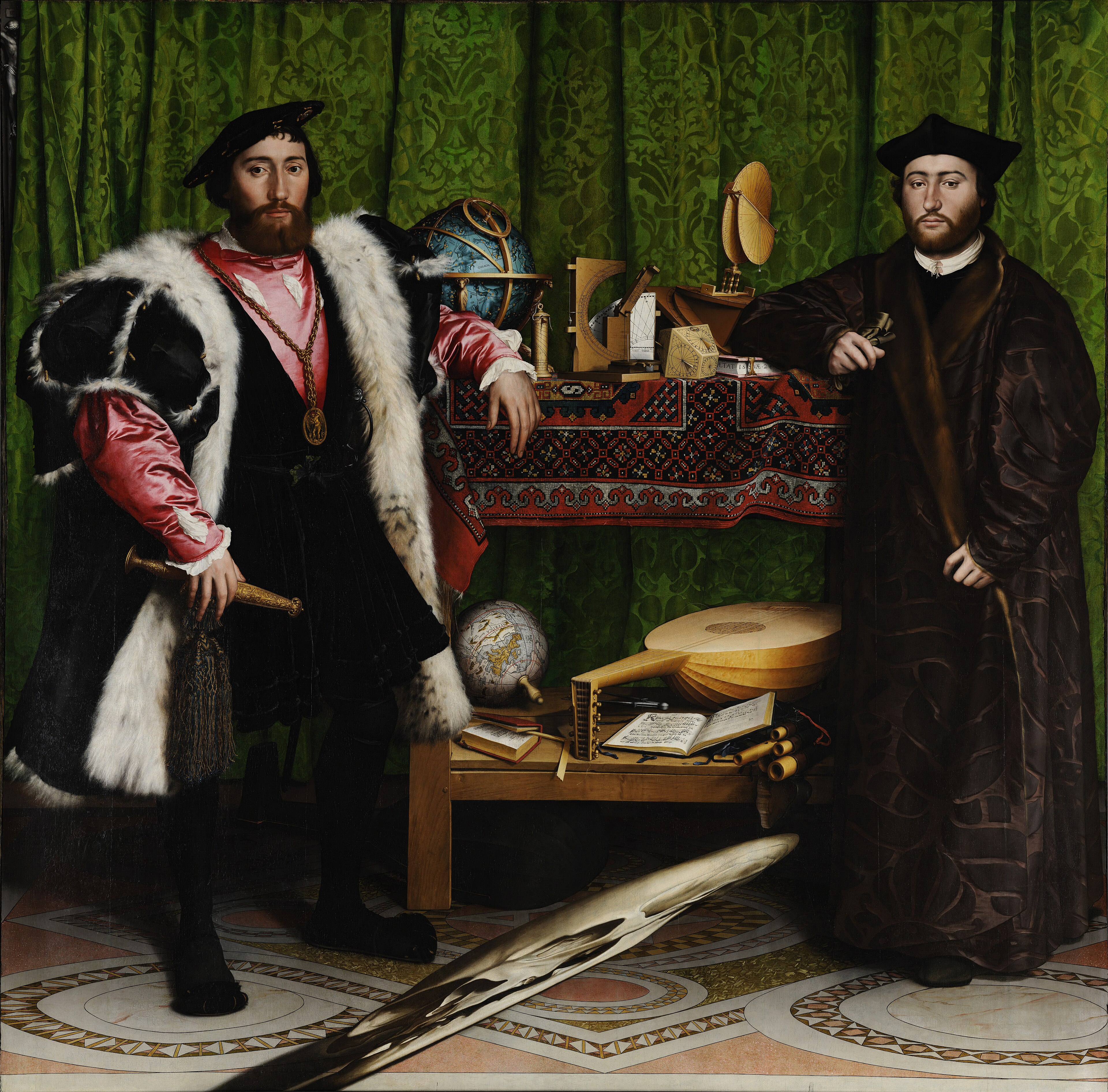
Two men stand in front of a green curtain and look out at us. Between them is a table with two shelves, so crowded with objects that the portrait can almost pass for a display of learning. The fur looks soft, the pink satin catches the light, and the measuring instruments promise precision. Down below, a long, pale shape cuts across this carefully arranged space. From the viewpoint that makes everything else look natural, it refuses to come into focus.
Hans Holbein the Younger painted The Ambassadors in 1533. The date and his Latin signature are on the floor at lower left. The nearly square oak panel stands more than two metres tall. At that scale, we meet the two men almost as equals. The painting is now in the National Gallery in London, where it is catalogued as NG1314.
Holbein left no surviving key to the painting’s symbols. We can identify some objects with confidence and even read the lines printed in the books. Their meaning as a group takes more work to recover. We will keep those two kinds of claim distinct. Each detail comes from the same reproduction. Select one to see the full composition.
London in 1533, an alliance under strain
Behind the composed poses lay a tense diplomatic situation. Henry VIII sought to have his marriage to Catherine of Aragon declared invalid. His decision to marry Anne Boleyn despite Rome’s opposition was reshaping the English Crown’s relations with the papacy and other European rulers. Francis I of France needed England as an ally in his rivalry with Emperor Charles V. For his ambassador, the events in London mattered as European politics as much as Tudor family history.
Henry married Anne in 1533. She was crowned on 1 June, and the future Elizabeth I was born in September. The Act of Supremacy formally declared the king head of the English Church the following year, in 1534. Holbein painted while the crisis was still unfolding.
The Reformation was already dividing Western Christendom. A simple story about the triumph of science over religion misses that complexity. The instruments, church music and crucifix share the same space here. For an educated person in the sixteenth century, the study of the world could be closely bound up with faith.
Jean de Dinteville and Georges de Selve
On the left is Jean de Dinteville, Francis I’s representative at the English court. His friend Georges de Selve stands on the right. De Selve was associated with the bishopric of Lavaur and had diplomatic experience of his own. He visited London briefly, and the precise nature of any assignment there remains unknown. The familiar title The Ambassadors leaves open whether the two men were part of the same mission.
Dinteville’s letters reveal the man behind the splendour of the portrait. He was finding his posting in England hard, and his friend’s visit brought him real pleasure. The painting can also be seen as a record of their meeting. Dinteville was involved in commissioning it, and it later hung at his French estate of Polisy.
Notice how differently the two men take up space. Dinteville stands with his feet apart, his fur cloak broadening his silhouette. De Selve looks more reserved and composed. Both lean on the table. Their bearing suggests the contrast between service at court and a life of clerical learning, though each life encompassed both thought and action.
 View
Image
Hans Holbein the Younger, The Ambassadors (1533), NG1314. The National Gallery, London. Reproduction: Google Art Project, via Wikimedia Commons (PD-Art). Detail windows show this same unaltered file.Public domain (PD-Art) · Museum record · Terms of use
Numbers on a dagger sheath and a book
The gold-coloured sheath of Dinteville’s dagger bears the age inscription AET. SVAE 29. The edge of the book under de Selve’s elbow reads AETATIS SVAE 25. The numbers 29 and 25 fix these formal likenesses at particular moments in the sitters’ lives. The Latin can be read as an age or a year of life. The surest starting point is the lettering we can see.
The sheath and the book both help characterise their owners. One man touches a weapon, and the other leans on a book. Holbein also uses both objects as surfaces on which to give us biographical information. A single object can have a practical purpose, tell us something about a sitter and carry a symbolic meaning.
ViewImage
Hans Holbein the Younger, The Ambassadors (1533), NG1314. The National Gallery, London. Reproduction: Google Art Project, via Wikimedia Commons (PD-Art). Detail windows show this same unaltered file.Public domain (PD-Art) · Museum record · Terms of use
Fur, satin and the Order of Saint Michael
Pink satin, fur and a substantial gold chain show Dinteville’s standing at the French court. The pendant on his chest bears the insignia of the Order of Saint Michael, with the archangel striking a dragon. It marks a recognisable distinction conferred by the Crown. The original paint in the area of the pendant has been lost entirely, and the image we see today is a restorer’s work. Documents confirm Dinteville’s membership in the order. The pendant’s finest details belong to the restoration.
The Christian subject can also evoke the defeat of evil. Reading the pendant as a declaration of war on English ‘heresy’ would go further than the evidence supports. The order itself is readily identifiable, while any such political message remains conjectural.
Compare the gleam of the chain with that of the satin beside it. Holbein varies the highlights so we can imagine the weight and texture of each material. The wealth feels almost tangible. It is this world that the skull will call into question.
ViewImage
Hans Holbein the Younger, The Ambassadors (1533), NG1314. The National Gallery, London. Reproduction: Google Art Project, via Wikimedia Commons (PD-Art). Detail windows show this same unaltered file.Public domain (PD-Art) · Museum record · Terms of use
The upper shelf measures the sky and time
On the left stands a celestial globe marked with figures of the constellations. Beside it is a cylindrical sundial known as a shepherd’s dial. Nearer the centre are a quadrant and the parts of an equinoctial sundial. The pale many-sided object with dials on its faces is another kind of sundial. On the right rises a torquetum, an instrument for relating observations to different systems of astronomical coordinates.
These devices do different jobs. They measure a celestial body’s altitude, relate its position to the time, or express an observation geometrically. With the celestial globe, they offer a collection of ways to describe the sky. Related instruments appear in Holbein’s portrait of Nikolaus Kratzer, Henry VIII’s court astronomer. The comparison is useful, though Kratzer’s involvement in planning The Ambassadors remains unestablished.
Together with the arithmetic and music on the lower shelf, the instruments recall the four mathematical disciplines of the traditional quadrivium, arithmetic, geometry, music and astronomy. The objects display the sitters’ access to knowledge. Some, including the celestial globe, also signal their standing.
ViewImage
Hans Holbein the Younger, The Ambassadors (1533), NG1314. The National Gallery, London. Reproduction: Google Art Project, via Wikimedia Commons (PD-Art). Detail windows show this same unaltered file.Public domain (PD-Art) · Museum record · Terms of use
Can the instruments tell us a single date?
Popular accounts sometimes promise to read one precise message from all the instruments, down to Good Friday, 11 April 1533. The historian John North linked the painting to that date. His reading remains a hypothesis.
The National Gallery’s catalogue discusses conflicting readings as well as awkward angles and scales. The painted instruments do not always reveal their settings as clearly as working instruments would. The same evidence leaves open whether Holbein meant the devices to appear faulty as an image of cosmic disorder.
We can see different instruments for measurement and consider what they suggest about order, time and the limits of knowledge. Reading them as a precise calendar code requires further assumptions.
The terrestrial globe, from the wider world to tiny Polisy
On the lower shelf, a terrestrial globe answers the celestial sphere above. It puts geography, travel and the political division of space before us. Europe and Africa are visible, along with names associated with France. One is especially striking: Polisy, Dinteville’s estate. A model of the vast world takes on a personal point of reference.
Polisy’s position on the painted globe is slightly at odds with its actual location. The discrepancy cautions against taking every cartographic detail literally. Including the owner’s home mattered to the painter more than providing a chart for navigation.
The globe also marks a line dividing Spanish and Portuguese possessions. The detail recalls how the cartography of the age of exploration served the claims of European powers. Naming and mapping a place went hand in hand with the desire to control it.
ViewImage
Hans Holbein the Younger, The Ambassadors (1533), NG1314. The National Gallery, London. Reproduction: Google Art Project, via Wikimedia Commons (PD-Art). Detail windows show this same unaltered file.Public domain (PD-Art) · Museum record · Terms of use
Arithmetic and the meaning of division
The book below the globe has been identified as Peter Apian’s manual of commercial arithmetic, first published in 1527. The visible page deals with division. Nearby are a set square or folding rule and a pair of dividers. These are tools for working with numbers, proportions and measurements.
The word Dividirt invites a connection between mathematical division and a divided Europe. That association fits other details and often appears in interpretations of the painting. The calculation is legible on the page. Its political meaning is a matter of interpretation.
Skill in calculation could be a source of pride, and the book could attest to its owners’ learning. The tension comes from the fact that a single object can sustain several readings.
The lute and flutes suggest harmony interrupted
The lute takes up much of the lower shelf. One string is visibly broken, impairing an instrument made to produce harmony. A flute case lies under the neck. The National Gallery catalogue notes an empty space that might have held another flute. The lute’s own dark case is visible on the floor.
Musical harmony could stand for agreement between people and states. The broken string can plausibly suggest religious discord, political discord or a more general sense of division. The painting leaves the specific conflict open.
Emblems of the period sometimes compared a political alliance to a tuned lute: concord fails when its members cease to sound together. Holbein’s contemporaries would have recognised that association. Whether he borrowed a particular emblem remains uncertain.
ViewImage
Hans Holbein the Younger, The Ambassadors (1533), NG1314. The National Gallery, London. Reproduction: Google Art Project, via Wikimedia Commons (PD-Art). Detail windows show this same unaltered file.Public domain (PD-Art) · Museum record · Terms of use
Lutheran hymns beside a Catholic cleric
The open music book shows two hymns from Johann Walther’s Lutheran hymnal. The hymn on the left, ‘Komm, heiliger Geist, Herre Gott’, invokes the Holy Spirit. The one on the right, ‘Mensch, willst du leben seliglich’, sets out the Ten Commandments in verse. Holbein brought together two pages that do not face one another in the printed book.
The choice is striking because both men were Catholic. The book gives us no grounds to imagine them as secret Protestants. Prayer and the commandments could recall a common ground for Christian unity, especially beside the damaged instrument.
De Selve’s concern with overcoming religious divisions lends weight to that reading. The unusual pairing of hymns is visible. Its possible appeal for reconciliation comes from the historical context.
ViewImage
Hans Holbein the Younger, The Ambassadors (1533), NG1314. The National Gallery, London. Reproduction: Google Art Project, via Wikimedia Commons (PD-Art). Detail windows show this same unaltered file.Public domain (PD-Art) · Museum record · Terms of use
The carpet brings luxury from afar
A patterned carpet covers the upper shelf. Its geometric design is associated with Anatolian weaving. Textile historians use the name ‘Holbein’ for a type of carpet that appears in European painting. The name refers to those appearances in art.
The carpet protects the table, sets off the objects on display and is itself a valuable trading good. It extends the painting’s geography beyond England and France. Its presence alone speaks to material connections between regions.
ViewImage
Hans Holbein the Younger, The Ambassadors (1533), NG1314. The National Gallery, London. Reproduction: Google Art Project, via Wikimedia Commons (PD-Art). Detail windows show this same unaltered file.Public domain (PD-Art) · Museum record · Terms of use
The geometry of the world underfoot
The floor’s circles, polygons and coloured inlays recall the Cosmati pavement at Westminster Abbey. The Abbey’s floor was laid in 1268, and its inscriptions linked the geometric design to the structure and duration of the world. Anne Boleyn was crowned at Westminster in 1533.
Holbein alters the design. The resemblance suggests a possible model for the painted setting and cannot establish that the two friends posed inside the Abbey.
A possible cosmological meaning comes into focus beside the globes. The men stand on orderly geometry with models of the world within reach. The eye then meets the skull, a shape that disrupts the view from straight on. The connection between these motifs offers one way to read them.
ViewImage
Hans Holbein the Younger, The Ambassadors (1533), NG1314. The National Gallery, London. Reproduction: Google Art Project, via Wikimedia Commons (PD-Art). Detail windows show this same unaltered file.Public domain (PD-Art) · Museum record · Terms of use
The skull asks us to look from another angle
The elongated shape in the foreground is a human skull. Holbein painted it in anamorphosis. It looks severely distorted from the front and becomes recognisable at an oblique angle. The National Gallery suggests looking along the painting’s surface from the lower right.
Zooming in on a reproduction helps reveal the paint and the contours. The anamorphosis still depends on the geometry of your view. Try looking at the screen almost edge-on from the right. Its size and position will affect how well you can see the effect.
A skull is a traditional reminder of mortality, a memento mori. Here its force comes from what it asks the viewer to do. To see it differently, we give up the comfortable position from which the faces, fabrics and instruments were clear. A single vantage point cannot show us everything in the picture.
One suggestion is that the painting originally hung near a staircase or doorway, where the skull might have disclosed itself unexpectedly. The original arrangement remains uncertain. The attractive story of a viewer encountering the picture in two stages is a reconstruction.
ViewImage
Hans Holbein the Younger, The Ambassadors (1533), NG1314. The National Gallery, London. Reproduction: Google Art Project, via Wikimedia Commons (PD-Art). Detail windows show this same unaltered file.Public domain (PD-Art) · Museum record · Terms of use
A second skull in plain sight
A little skull badge sits on Dinteville’s hat. It is easy to overlook beside the huge anamorphic skull. The pair links a close look at what he wears with one of the painting’s larger themes. Death is present in both the sitter’s formal dress and the space in front of him.
The National Gallery’s catalogue finds no evidence that Dinteville used the skull as a personal emblem or motto. We can see the badge clearly. The reasons for choosing it remain open.
ViewImage
Hans Holbein the Younger, The Ambassadors (1533), NG1314. The National Gallery, London. Reproduction: Google Art Project, via Wikimedia Commons (PD-Art). Detail windows show this same unaltered file.Public domain (PD-Art) · Museum record · Terms of use
The crucifix behind the curtain
At the top left, a small crucifix appears at the turned-back edge of the green fabric. The large skull spans the foreground, while this detail nearly disappears at the edge. The curtain leaves enough of the crucifix visible for an attentive viewer to find.
In a Christian reading, the crucifix brings the hope of redemption into the painting’s reflection on death. Wealth, knowledge and human endeavour meet their limits. The prospect of salvation remains.
The crucifix is easy to miss because Holbein chose to place it there. That choice reveals little by itself about his private beliefs or about the place of God in the world he depicts. Look again at the whole painting. Once noticed, this barely visible object changes how the other things relate to one another.
ViewImage
Hans Holbein the Younger, The Ambassadors (1533), NG1314. The National Gallery, London. Reproduction: Google Art Project, via Wikimedia Commons (PD-Art). Detail windows show this same unaltered file.Public domain (PD-Art) · Museum record · Terms of use
Putting the details back together
A close look makes it easier to see what the objects do together. The globes model heaven and earth. The books let us calculate and sing. The instruments promise precision, and a broken string interrupts the harmony. Age inscriptions, two skulls and a crucifix bring in time, mortality and the possibility of salvation.
The historical context sharpens these connections. The break with Rome is one part of a picture that also holds friendship, a sense of personal dignity and a painter’s pleasure in making surfaces feel almost tangible. The details make the encounter with these two people more complex.
Sources
- National Gallery · The Ambassadors, NG1314
- Susan Foister · The Ambassadors, in The German Paintings before 1800 (2024)
- UK Parliament · Act of Supremacy, 1534
- Westminster Abbey · Cosmati pavement
- The Metropolitan Museum of Art · ‘Holbein’ carpet
- History of Science Museum, Oxford · Schöner’s celestial globe
- Wikimedia Commons · Google Art Project reproduction and PD-Art status
- Video essay · The Strangest Painting in History: Holbein’s Ambassadors
Hans Holbein the Younger, The Ambassadors (1533), NG1314. The National Gallery, London. Reproduction: Google Art Project, via Wikimedia Commons (PD-Art). Detail windows show this same unaltered file.
Public domain (PD-Art) · Museum record · Terms of use