Whose gaze are we meeting?
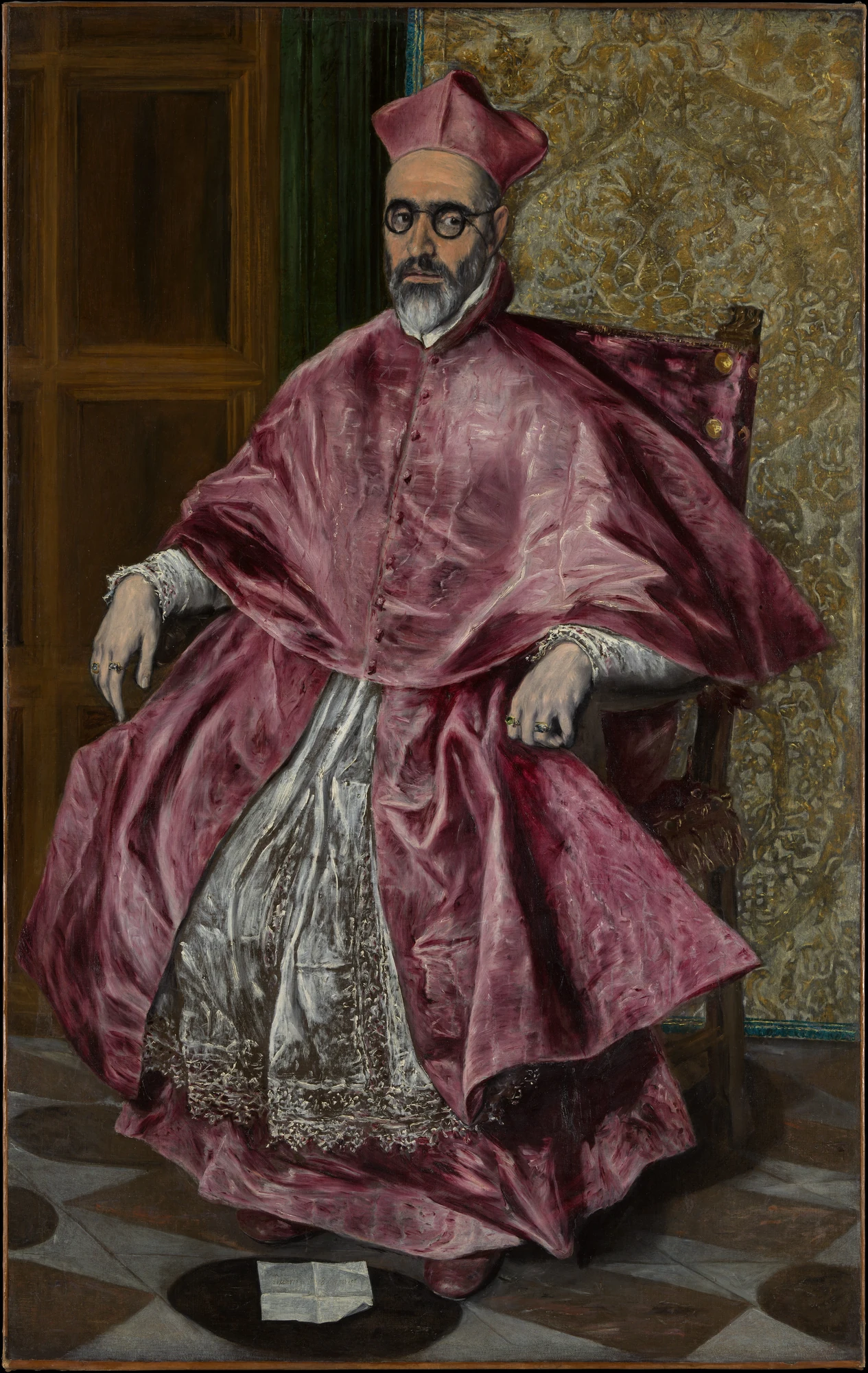
El Greco painted this portrait around 1600. The Metropolitan Museum of Art identifies the cardinal as Fernando Niño de Guevara, who served as grand inquisitor of Spain, though its Spanish-language entry describes the identification as probable. Before you know his name, you can see how directly he looks at you. The thin, dark rims of his spectacles give the gaze a geometric precision. Two scales of the painting meet here: the tiny circles on the face and a broad field of red that commands attention at almost any distance.
Tension in a still pose
Look at each hand separately. On the viewer’s left, the fingers rest loosely along the armrest. On the right, they draw together and curl. The upper body scarcely seems to move. The large red garment has a geometry of its own. It breaks up into angular planes that draw the eye down and away from the shoulders. Imagine swapping the positions of the hands. The tense grip would disturb the calm in a different part of the picture. The contrast between them hints at the body underneath all that fabric and gives weight to the seated figure’s stillness.
What the red does
Look closely at the edges of the garment, where lighter fabric gives way to deep red shadows. The white under the chin keeps the face distinct against the red. The pattern behind the figure offers plenty of small details, but they hold the eye only briefly. Shrink the image and the spectacles and individual fingers disappear. The red silhouette and the white strip at its center remain. At full size, a few small details can change the character of a figure that already seemed easy to read.
Sources
- The Metropolitan Museum of Art · Cardinal Fernando Niño de Guevara
- The Metropolitan Museum of Art · Identification of the sitter, Spanish record
- The Metropolitan Museum of Art · El Greco (1541–1614)
H. O. Havemeyer Collection, Bequest of Mrs. H. O. Havemeyer, 1929
CC0 1.0 · Museum record · Terms of use